With Dada Chen at NYAFF 2013

With Dada Chen at NYAFF 2013

Thursday, February 01, 2007

ACF 020: Kelly Hu on the Tube


Beautiful and talented Asian-American film and television star Kelly Hu is once again viewable on a weekly television series, ABC's mid-season comedy In Case of Emergency. It's on Wednesday nights at 9:30 PM Eastern Time.

A former Miss Teen USA, Kelly got her start on the Growing Pains television show in the late '80s, and has since appeared in numerous shows and films. Her first noticeable film role was in Oliver Stone's The Doors, where she was billed as Kelly Ann Hu. I first became aware of her when she played Chen Pei Pei in the initially fantastic TV series Martial Law. Kelly's character was named after the famous Hong Kong actress Cheng Pei-pei who is best known to general Western audiences for her portrayal of the nefarious Jade Fox in Ang Lee's Crouching Tiger, Hidden Dragon.

In Martial Law, Kelly's character was the protoge of Hong Kong policeman Sammo Law, played by the great Sammo Hung. The show ran for two seasons from 1998 to 2000, but was ruined after the network suits brought in Arsenio Hall in an attempt to make a solid success into a break-out hit. Instead, they changed the dynamics from a fish-out-of-water to a buddy movie [think Rush Hour on TV]. Unfortunately they failed to realize that Hall, a has-been-who-never-was, certainly was no Chris Tucker. With this change, the show went straight into the toilet.

Anyway, after Marshal Law, Kelly went on to appear in The Scorpion King {2002]. Cradle 2 the Grave [2003], X2 [2003], in some significantly lesser movies, and in episodes of several TV shows.

In Case of Emergency is a 30 minute sitcom about four graduates from the same high school who are now in their thirties and who find that their lives have turned out differntly, and far worse, than they'd planned, hoped and expected. Kelly was the class valedictorian, but instead of becoming a top-notch lawyer, she's working in a "massage parlor." There she speaks to customers in a hilarious pseudo-Korean accent. The three male leads are all what one might charitably refer to as losers
I began watching this show just to see Kelly again. My expectations were low, but I was quite pleasantly surprised. The show is far better than I had ever dreamed. In fact, it's pretty damn good, especially for being fresh out of the gate. And Kelly, it turns out, is a terrific comedienne.

I say check it out. This show deserves to succeed, if for no other reason than so we can get our weekly fresh fix of Kelly Hu. Yummy!!!!!

Update 02.25.07 - For the past couple of weeks In Case of Emergency has been supplanted by special 2 hour episodes of the returning Lost series. ICoE is scheduled to return on Wednesday, February 28th, 2007, still at 9:30 E.S.T. on ABC. Be there, for Kelly, for yourself, and for some good laughs.

P.S. - I've got to mention that one episode that already aired featured David Carradine (Kill Bill, the various incarnations of Kung Fu) in a hilarious role as "Guru Danny." Here's hopin' it'll be a recurring role.

Kelly Hu links:
- Internet Movie DataBase
- Wikipedia
- Cult Sirens

Thursday, December 14, 2006

ACF 019: Chan Kwok-Kwan to play Bruce Lee


Earlier this month, Hong Kong newspapers reported that actor Chan Kwok-Kwan had been selected to portray Bruce Lee in a mainland Chinese television series that will recount the story of Lee's life in 40 episodes. .

As the goalkeeper in Stephen Chow's 2001 kung fu comedy Shaolin Soccer, Chan sported a Bruce Lee haircut and a yellow jump suit like the one Lee wore in Game of Death. The screen shot above shows Chan's strong physical resemblance to the late martial artist and movie star.

Chan previously has played Lee in commercials. He is said to have worked out, studied Lee's Jeet Kune Do martial art, and submitted tapes of himself impersonating Lee to his widow and daughter. They were consulted in the casting for the TV series and approved of his being selected.

Maybe we Westerners will eventually be able to get a subtitled, condensed version of the series on DVD.

Thanks to AsianCineFest reader Edgar Serrano for tipping me off about this interesting story.

The Associated Press article about this announcement was carried by washingtonpost.com and can be accessed by clicking on this link.

Monday, November 27, 2006

ACF 018: Bruce Lee Remembered

Bruce Jun Fan Lee
Born November 27, 1940, San Francisco
Died July 20, 1973, Hong Kong

Bruce Lee was the single person most responsible for reinventing and reinvigorating the Asian martial movie and making the genre popular in the United States and other western countries. Born in the U.S. to Chinese parents who were touring with a Chinese opera company, he grew up in Hong Kong, but returned to the U.S. in 1959. Most accounts attribute his return to his father's concern for his safety after Bruce got in a fight with the son of a feared Triad [Chinese criminal gang] member. He majored in Philosophy at the University of Washington, where he met his future wife Linda Emery. They later had two children. Son Brandon Lee, was born in 1965 and died in a tragic weapons accident on March 31, 1993 while filming The Crow. Daughter Shannon Lee, born 1969, is an actress. Interestingly her first credited film role was as the Party Singer in Dragon: The Bruce Lee Story, the under-rated 1993 bio-pic of her father. Lee was the real deal - a true martial arts master. He developed his own martial arts system, known as Jeet Kune Do or the Way of the Intercepting Fist. A non-formalized style, it emphasized "practicality, flexibility, speed and efficiency." [source: Wikipedia]
Lee appeared in films from a young age because of his parents being in Chinese opera. However, it was in the United States, after he began teaching martial arts to such film stars as Steve McQueen and James Coburn, that his career really began. He starred as Kato in the 1966-67 television series The Green Hornet. Reportedly, he felt that his future in Hollywood was limited after he was passed over for the role of Kwai Chang Caine in the Kung Fu TV series, a role that went instead to David Carradine.

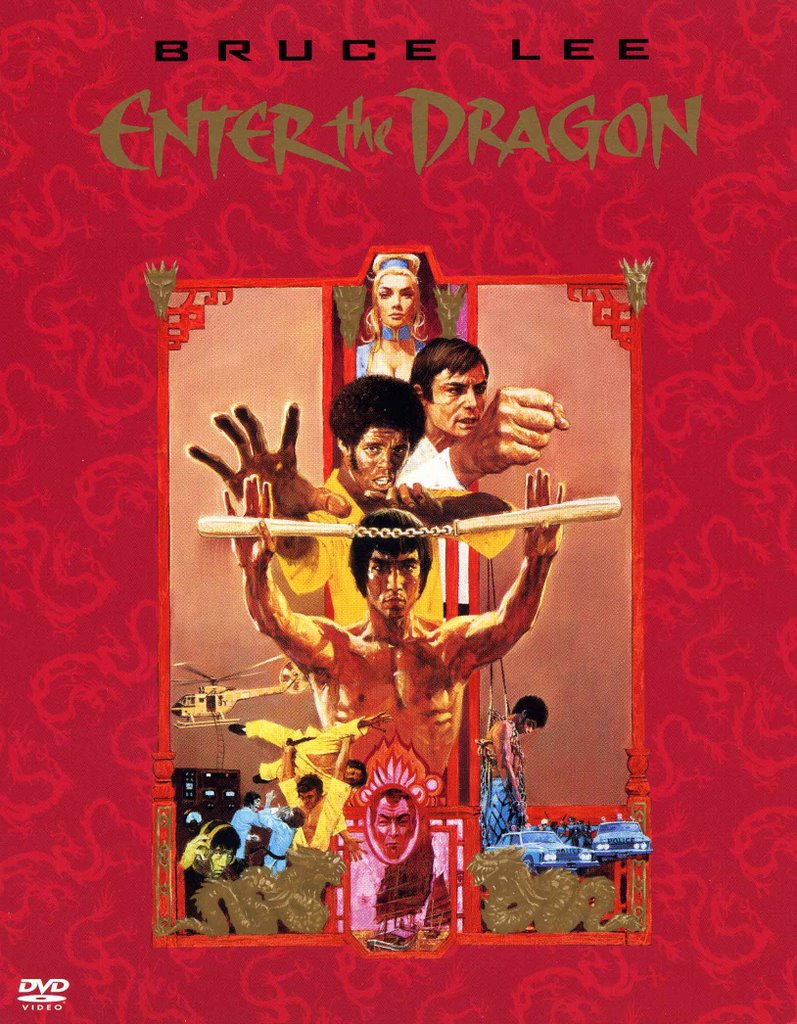
Bruce returned to Hong Kong, where film producer Raymond Chow offered him the lead in Tang sha da xiong, or The Big Boss in English. The film was a huge hit, as were his next two films. But it was with the Warner Brothers financed Enter the Dragon that Bruce's international reputation was immortalized. The final fight in the room of mirrors is one of the most iconic of all martial arts film sequences.

Sadly, Bruce died before the film premiered. He was visiting actress Betty Ting Pei, who gave him one of her prescription pills because he had a headache. He had an adverse reaction, could not be revived, and died later that day of cerebral edema.

He is most fondly remembered for:
The Big Boss (a.k.a. Fists of Fury), 1971
Fist of Fury (a.k.a. The Chinese Connection), 1972
Way of the Dragon (a.k.a. Return of the Dragon) 1972
Enter the Dragon, 1973
Game of Death, 1978 (Most of this film was shot after his death using a stand-in for Bruce. Still, the last sequence, as the real Bruce fights his way up a pagoda, facing increasingly difficult opponents on each successive floor, is fantastic. It plays like a series of boss fights in a live action video game.)

Only the first two of these were released in the United States prior to his death.
Enter the Dragon is available on DVD from Warner Brothers. The other four films can be found in Bruce Lee: The Master Collection from 20th Century Fox, which also includes a bonus disc of documentary footage. They are, however, dubbed versions. It would be great if at some point the original versions, with good subtitles, become available. In the meanwhile, all of these films are wonderful ways to remember Bruce and keep his spirit alive. [Update 11.28.06: Yesterday the head of the Bruce Lee Fan Club in Hong Kong announced plans for a $25.5 million dollar theme park that will be built in Lee's ancestral home of Shunde. It is to include a statue, a memorial hall, a martial arts academy, and a conference center. In 2005 a bronze statue of Bruce was unveiled in Hong Kong to mark his sixty-fifth birthday. Sources: New York Times, 11.28.06, pg E2 and Wikipedia.]

Friday, November 24, 2006

ACF 017: Korean Cinema Special Issue


The new special collector's issue of Asian Cult Cinema magazine has come out. Featuring a cover photo of actress Kim Yun-Jin (star of TV's Lost) looking very hot in a blue two piece swimsuit, issue #52 is a "Who's Who In Korean Cinema." Twenty-nine pages are devoted to actresses, six to directors, and twenty-four to actors. There's a photo and a filmography of each individual. The one article is "Korean Cinema Now" by Art Black, a regular contributor to the magazine. Art succinctly describes how Korean Cinema (which of course means the film industry of South Korea) has emerged as a vital force since roughly 1999.

If you're interested in or curious about Korean Cinema, this truly is a "must-have" issue. Pick up a copy or use the link at the top of the column on the right.

Below, in alphabetical order, is a list of some of the terrific Korean films that I've seen and highly recommend. As does the magazine, I've used the traditional Korean format that places the family name first.

Attack the Gas Station! [Juyuso seubgyuksageun] (1999) Kim Sang-Jin, dir. When the proceeds from robbing a gas station aren't satisfactory, some young would-be toughs go back and take it over in this hilarious crime comedy caper.

The Isle [Seom] (1999, or 2000) - Kim Ki-Duk, dir. A man on the run hides out at a remote fishing resort run by a young mute woman. Fish hooks will never be the same after you watch this not-for-the-faint-of heart movie.

Oasis (2002) - Lee Chang-Dong, dir. Starring Moon So-Ri as a woman with cerebral palsy and Sol Kyung-Gu as a young man with limited intellectual functioning. An "art house" film that's not "artsy-fartsy." Many will find Ms Moon's performance painful to watch at first, but stick with it. It's truly Oscar worthy. I could not stop thinking about this film for days after I first saw it. Pretty much felt the same way after subsequent viewings. Incredible cinema.

Oldboy (2003) - Park Chan-Wook, dir.; starring Choi Min-Sik. This is the middle film of Park's "vengence trilogy" that begins with Sympathy for Mr. Vengeance (2002) and concludes with Sympathy for Lady Vengeance (2005)

Samaria (2003) - Kim Ki-Duk, dir. Kind of a "reverse revenge" tale (an "amends" tale?) about two teenage girls, one who turns tricks, the other her manager.

Save the Green Planet! [Jigureul jikyeora!) (2003) - Jang Jun-Hwan, dir. A wacky genre-blending flick about a youth who believes aliens are among us and that he knows how to identify them.

Shiri [Swiri] (1999) - Kang Je-Gyu, One of the most important films that contributed to the rise of Korean Cinema. Uniquely Korean issues are infused in this actioner that showed Korea product could hold its own against Hollywood. A box office record breaker.

Spring, Summer, Fall, Winter...and Spring [Bom yeoreum gaeul gyeoul geurigo bom]- Kim Ki-Duk, dir. A young boy is raised by an old Buddhist monk on a small temple that floats on a lake. In this tale, cyclical as its name suggests, the boy turns into a young man and leaves, only to return years later. Kim also stars as the adult incarnation of the boy.

Monday, November 20, 2006

ACF 016: Curse of the Golden Flower


Top: Gong Li as The Empress and Chow Yun-Fat as The Emperor

Middle: This film won't lack for action!

Bottom: Li Man as Chan, the daughter of and apprentice to the Imperial Doctor


Looks like we're going to have a real treat this holiday season. Mainland China director Zhang Yimou 's Curse of the Golden Flower is set to be released by Sony Pictures Classics on December 22, 2006.

It's a story of court intrigue and deception involving The Emperor, The Empress (his second wife), and his three sons. Illicit affairs, rivalries, and betrayals abound.

Sumptuous cinematography is a given, as the above stills attest. Ditto the acting by the principals. The only question is will the story be as compelling as that of Zhang's Hero, or will the plot suffer from too many twists and tricks like his House of Flying Daggers? I can hardly wait to find out. I usually don't like to go to movies when they first open, but I've got a feeling that I just might in this case.

For all kinds of good stuff related to the film, check out the official website by clicking here.